Where the rule comes from
The 20-60-20 framework comes from Julie Holmes, who teaches business leaders to work with AI. Her starting point is to treat AI like a bright new intern: quick and eager, but it needs clear instructions at the start and a proper review at the end.
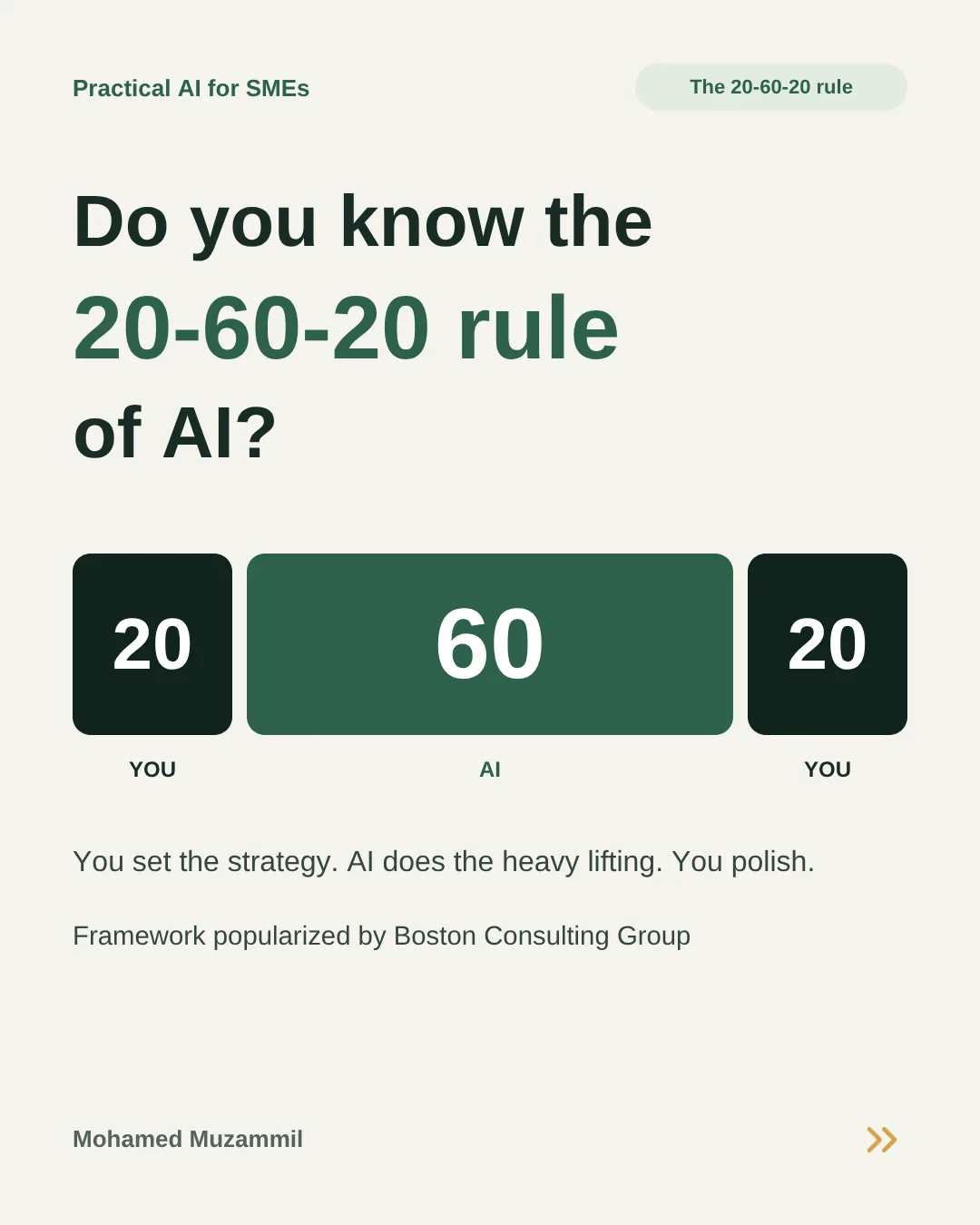
So every job splits into three parts. You spend the first 20% setting the strategy, AI does the middle 60%, and you spend the last 20% reviewing and polishing. The numbers are a guide to effort, not a measurement. What matters is that both ends stay with you.
Read her original: Work smarter with AI: the 20-60-20 framework.
Why the ends matter
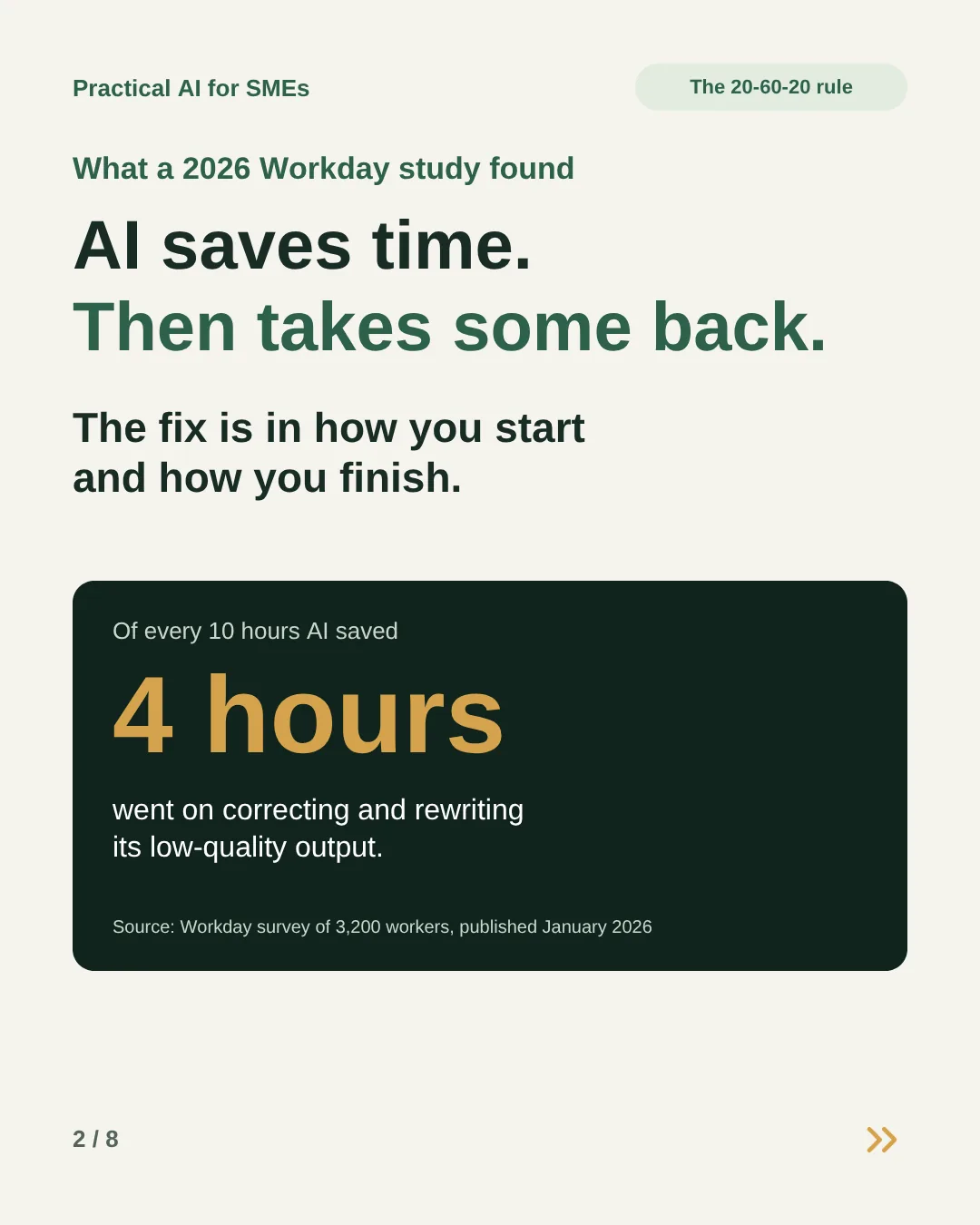
AI saves time, then takes some of it back. In a survey published in January 2026, Workday asked 3,200 workers how AI was going. Most said it saved them hours each week. But for every 10 hours it saved, almost 4 went on correcting, clarifying and rewriting low-quality AI output.
That’s what the two ends of the rule are for. A clear setup at the start means less to fix. A proper check at the end catches what’s still wrong before a customer sees it.
The people surveyed work at larger companies, so it isn’t a small-business study. The pattern is the one most owners know already: a vague request gets a vague draft, and a vague draft takes longer to fix than to write.
Source: HR Dive on the Workday research, 21 January 2026. Survey by Hanover Research, November 2025.
The three parts
-
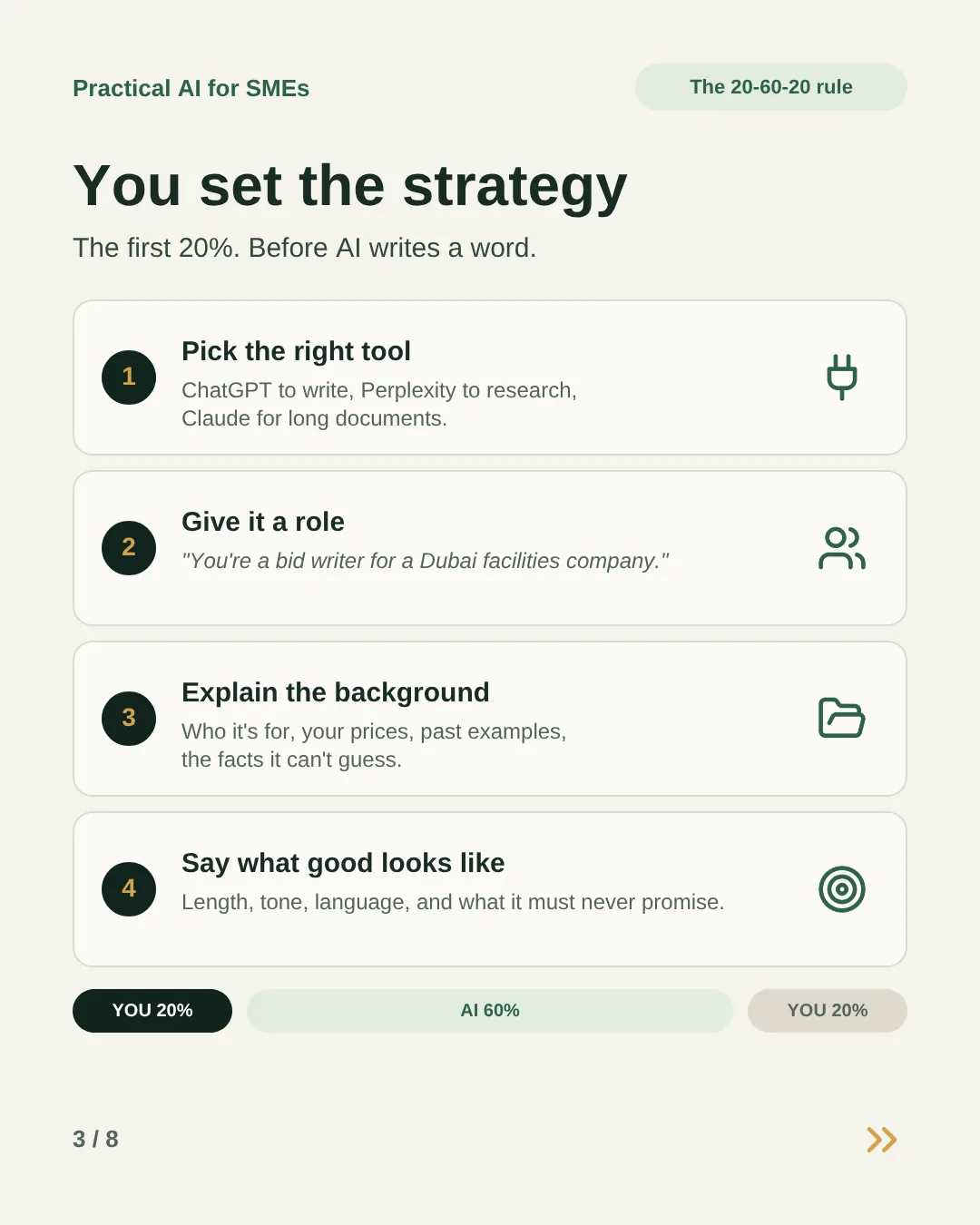
First 20% · you
Set the strategy
- Pick the right tool. ChatGPT to write, Perplexity to research with sources, Claude for long documents.
- Give it a role. "You’re a bid writer for a Dubai facilities company."
- Explain the background. Who it’s for, your prices, past examples and the facts it can’t guess.
- Say what good looks like. Length, tone, language, and what it must never promise.
-
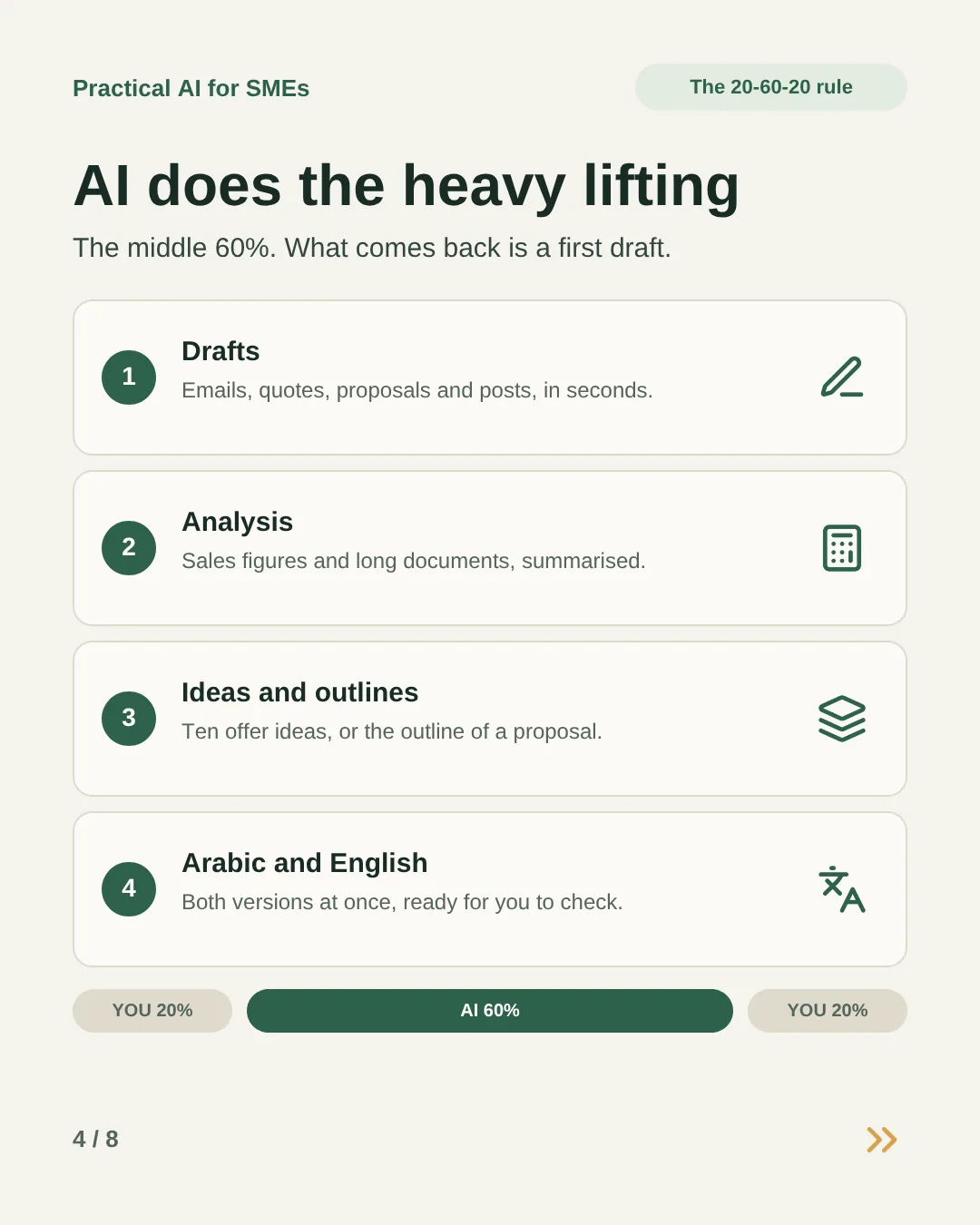
Middle 60% · AI
Do the heavy lifting
- Drafts. Emails, quotes, proposals and posts, in seconds.
- Analysis. Sales figures and long documents, summarised.
- Ideas and outlines. Ten offer ideas, or the outline of a proposal.
- Arabic and English. Both versions at once, ready for you to check.
Whatever comes back is a first draft, never the final version.
-
Last 20% · you
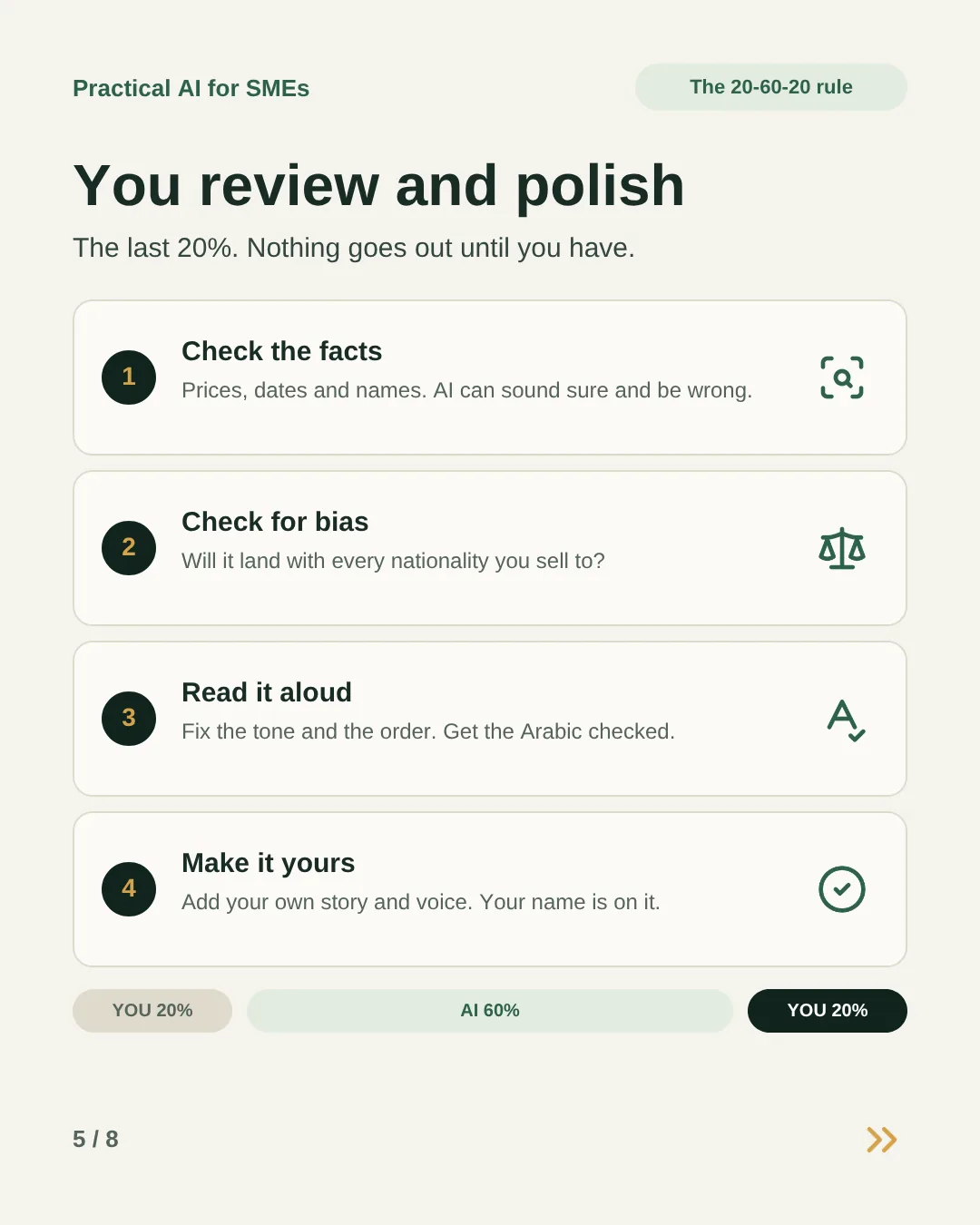
Review and polish
- Check the facts. Prices, dates and names. AI can sound sure and be wrong.
- Check for bias. Will it land with every nationality you sell to? A UAE customer base is too mixed for one set of assumptions.
- Read it aloud. Fix the tone and the order, and get the Arabic checked by a native speaker.
- Make it yours. Add your own story and voice. Your name is on it.
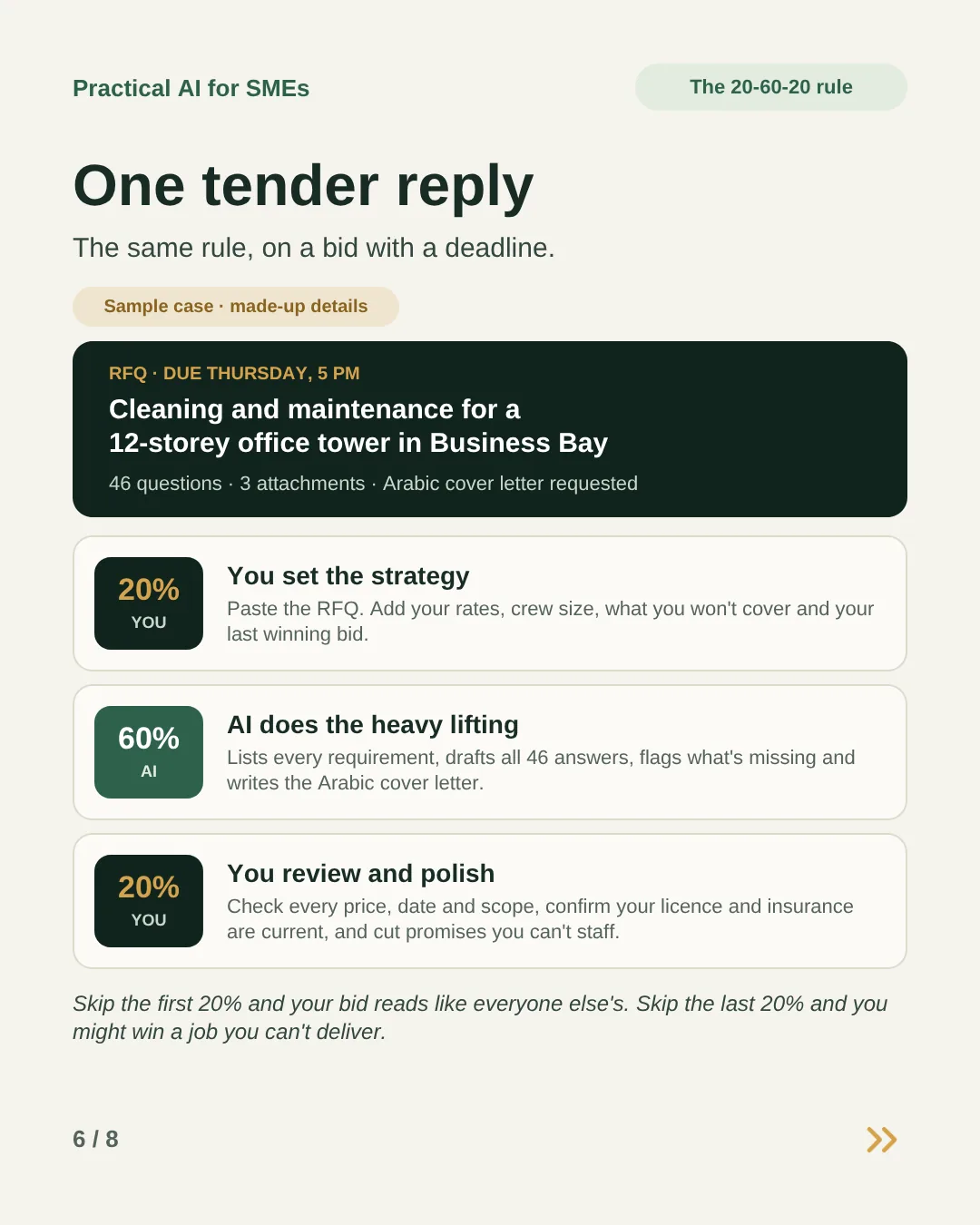
One tender reply, start to finish
Sample case · made-up details
- You set the strategy (20%). Paste the RFQ. Add your rates, crew size, what you won’t cover and your last winning bid.
- AI does the heavy lifting (60%). It lists every requirement, drafts all 46 answers, flags what’s missing and writes the Arabic cover letter.
- You review and polish (20%). Check every price, date and scope, confirm your trade licence and insurance are current, and cut any promise you can’t staff.
Skip the first 20% and your bid reads like everyone else’s. Skip the last 20% and you might win a job you can’t deliver.
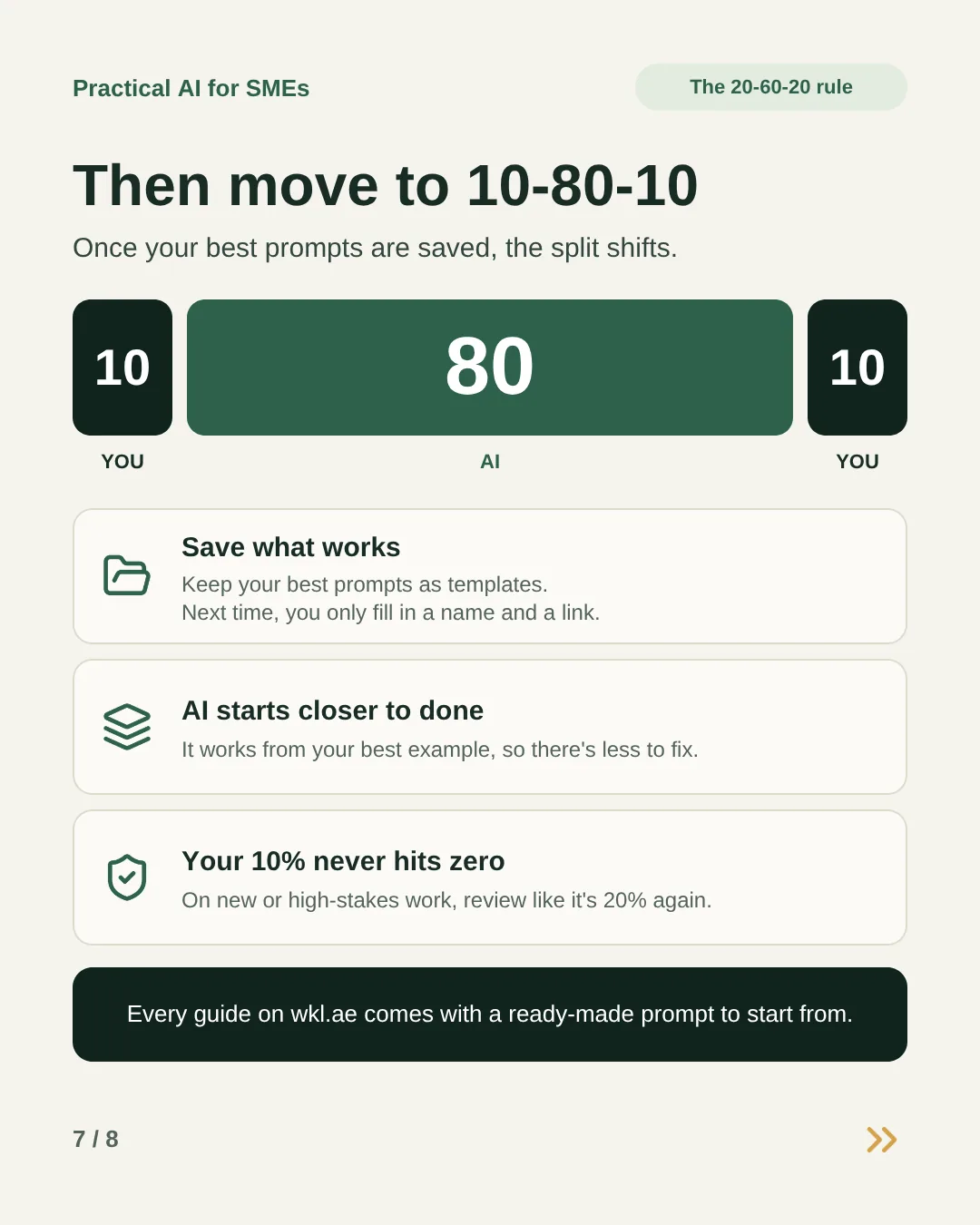
Then move to 10-80-10
The split isn’t fixed. Holmes’s tip is that once you have strong prompts and templates you reuse, AI can take on about 80% of the work. Your part at the start shrinks to filling in a few details, and there’s less to fix at the end because the first draft starts from your best example.
- Save what works. When a prompt gives you a good result, keep it as a template. Next time you only fill in a name and a link.
- AI starts closer to done. It works from your best example, so the draft needs less polishing.
- Your 10% never hits zero. That last check stays. On new or high-stakes work, review like it’s 20% again.
That’s the idea behind every guide on wkl.ae: each one comes with a ready-made prompt, so you start at 10-80-10 instead of a blank page. Browse the guides.
A prompt to start any job
You are [a role, e.g. a bid writer for a Dubai facilities company].

Background:
- Who it's for: [customer, supplier or staff, and what they care about]
- What you need to know: [prices, rates, a past example that worked]
- Our tone: [how we talk to customers]

Aim: [what good looks like: length, format, language, and anything you must never promise]

Before you write anything, ask me the questions you need to do this well. Ask them all at once.

Then give me a first draft. Mark anything you're unsure about, and never invent prices, dates or names.
Once it gives you something you’d send, save the filled-in version as a template. That’s your first step to 10-80-10, and the plan below walks you through it.
Try it this week, step by step
Reading about the rule changes nothing. Running it on one real job does. This plan takes about two hours spread over a week, and by the end of it you’ll have your first saved template. Open a step to see exactly what to do.
Before you start, have these ready
- One job you do every week that takes 30 minutes or more.
- A past example of that job that went well: a quote that won, or an email that got a quick yes.
- The facts AI can’t guess: your prices, rates, terms and what you never promise.
- Any AI tool. A free plan is enough to start.
- A note on your phone for two numbers each time: minutes setting up and minutes fixing.
Pick one job5 minutes
Choose something you repeat every week, that takes at least 30 minutes, and where you know what good looks like. Good first jobs:
- Replies to quotation requests
- Supplier follow-ups and order chasers
- Tender and vendor registration questionnaires
- Customer notices in Arabic and English
- The weekly staff schedule message
Leave contracts and anything legal for later. They need the biggest last 20%.
Done when: you’ve picked one job and found one past example that went well.
Write your first 20%15 minutes
Copy the prompt above and fill in the brackets: a role, the background and the aim. Paste in your past example and the facts it can’t guess.
The aim is where most people are vague. Say exactly what good looks like, for example:
Aim: a reply under 150 words, in English with an Arabic version, that confirms the price, the delivery date and the payment terms. Never offer a discount.
Done when: someone new to your business could do the job from what you’ve written.
Let AI do the 60%5 minutes
Paste it into your AI tool. The prompt tells it to ask its questions first, so answer them all in one message. Then let it write the first draft.
Done when: you have a full first draft, with anything it was unsure about marked.
Do the last 20% with a checklist15 minutes
Go through the draft in this order:
- Facts. Every price, date, name and quantity, against your own records.
- Promises. Can you deliver everything it says, on time?
- Tone. Read it aloud. Would you say it to this customer?
- Arabic. Have a native speaker check it before it goes out.
Write down every fix you make, however small. That list is what gets you to 10-80-10.
Done when: you’d put your name on it, and you have a list of fixes.
Save it as a template10 minutes
Take the prompt that worked. Replace the details that change each time with [brackets]: the customer’s name, the job and the dates. Keep everything that stays the same: the role, your rates, your tone and your best example.
At the bottom, add your list of fixes as rules, for example:
Rules: always show prices including 5% VAT. Never promise delivery in under 3 working days.
Save it where you’ll find it again: a Claude Project, a ChatGPT project, a Gemini Gem or a note on your phone.
Done when: the next run only needs you to fill in the brackets.
Run it twice more10 minutes each, during the week
Use the template on the next two real jobs. Each time, note your two numbers: minutes setting up and minutes fixing. Every new fix goes into the rules at the bottom.
Done when: you’ve used the template three times in all.
Check if you’ve reached 10-80-105 minutes, at the end of the week
Compare your notes. You’re there when:
- Setting up takes under 5 minutes, because you only fill in the brackets.
- The fixes are small, and they’re new ones rather than the same ones again.
If you’re there, keep the final check and pick your next job. If not, the template usually needs a better example. Swap in your best past one and give it another week.
Done when: you know whether this job is at 10-80-10, and you’ve picked the next one.
When the draft isn’t good enough
- It sounds like everyone else
- Your first 20% is too thin. Add a past example that worked and say who it’s for.
- It makes up prices, dates or names
- Give it the facts, and keep the line “never invent prices, dates or names” in every prompt.
- It’s too long
- Put a limit in the aim, such as “under 150 words” or “one page”.
- The Arabic reads like a translation
- Ask for the Arabic to be written fresh, the way a native speaker would, and still get it checked.
- You fix the same thing every time
- That fix belongs in the template’s rules, not in your head.
- Setting up is still slow after a week
- The job may change too much from one time to the next. Pick one that repeats more closely.
⚠️ Good to know
- It works with any AI tool. The rule is about how you split the work, not which app you use.
- The bigger the stakes, the bigger the last part. A social post needs a read. A tender, a contract or a price list needs a line-by-line check.
- Keep a list of fixes. Every time you correct the same thing, add it to your template. Your setup gets better each week.
- Get the Arabic checked. AI Arabic is usually readable, but have a native speaker check anything that goes out under your brand.
Which part do you skip most often?The strategy at the start or the polish at the end? Tell me on LinkedIn.